
Home › RV Happy Hour Forums › Mods and Upgrades › Almost done with my new solar setup.
This topic contains 3 replies, has 3 voices, and was last updated by  Larry 2 weeks, 3 days ago.
-
AuthorPosts
-
August 21, 2015 at 8:40 am #14727
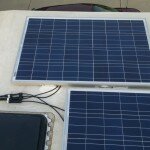
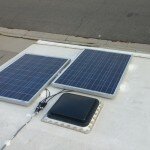
I finished wiring up my solar setup last night. I still need to by the Bogart Eng. Trimetric TM-2030 monitor (http://goo.gl/UfJPmb) but other than that I’m pretty much done.
This is a list of what I put into it.
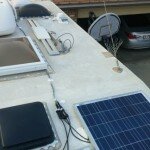
- Two 100 watt Polycrystalline panels http://goo.gl/ZvzlM7
- One Magnum Energy MM1212 Inverter/Charger http://goo.gl/fOjiqR
- One Bogart Eng. Trimetric SC-2030 Charge cont http://goo.gl/g4b8ru
- Two Trojan T-105 6v Batteries
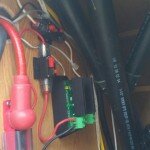
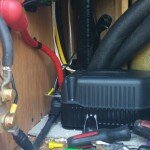
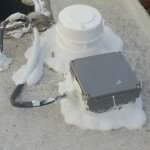
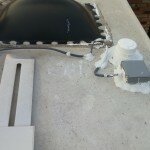
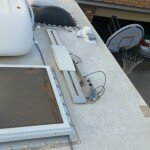
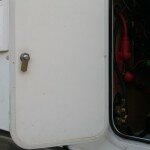
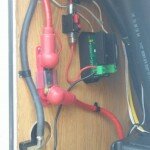
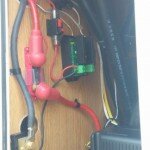
I ran #10 wire from the panels (13-14′) into the junction box. I drilled a hole in the side of the J-box and used a water tight threaded 1/2″ union. I then drilled a hole in the center of the J-box (down) and used another 1/2″ union. I drilled down into the roof using a 3/4″ bit. I caulked the hell out of it (as you can see, it got away from me and ended up on everything). The wire went straight down to the compartment where the inverter was. I placed the charge controller there and tied it into the system using the shunt and the 200 amp fuse. I lost that storage compartment but I think it will be worth it in the end. I originally had the inverter placed inside the camper. By moving it here I was able to eliminate 3-4′ of cable going to the batteries. Now the run to the batteries is about 3.5′.
I’m happy with it so far. I’m planning on a camp trip in a few weeks to put it to the test. I hope to have my monitor before then. :Party:

- This topic was modified 3 weeks, 4 days ago by
 Dave.
Dave.
- This topic was modified 3 weeks, 4 days ago by Dave.
Attachments:
August 21, 2015 at 9:21 am #14756Nice setup! That monitor/controller combo looks good. I was reading some of the stuff on the Bogart website.
This explanation on why they went with a PWM controller over an MPPT was interesting.
A very good question! They BOTH have good and bad. Plenty of hype has been written already. Here’s my (Ralph’s) view:
As you know, the Bogart Engineering SC-2030 Solar charger uses PWM technology, not MPPT.
The “good” for PWM:
It is simpler and lower cost technology.Under some circumstances–it can actually deliver more amps to the battery. That would be when:
(1)days are moderate or warm, with few clouds.
(2) batteries are charging at over 13 volts, (in a 12 battery system) which they almost always are when actually CHARGING. Many places that analyze MPPT charging assume batteries are charging at 12 or even 11 volts, which is unrealistic. Lead acid batteries are typically below 13 volts only when discharging, or perhaps charging with very little charging current–meaning the actual potential gain in amps is not great.
(3) Panel voltage is properly matched to the battery voltage, for example “12V” panels are being used with a 12V system. Some places that analyze MPPT assume that panels with 30V open circuit voltage are being used. Any good MPPT system will easily provide better performance in that case.PWM is actually more “power efficient” than MPPT–which means less total power loss in the controller itself. So heat sinks in the design can be smaller (and less expensive). Missing in most analysis of MPPT is that there is always a conversion loss with MPPT, which tends to be higher the greater the voltage difference between battery and panels. That’s why PWM can actually beat MPPT under circumstances described above.
The “good” for MPPT: If you use panels not voltage matched for the battery, MPPT will utilize more of the potential energy of the panels. For example, if you use 24 volt panels to charge a 12 volt battery system you must use MPPT, otherwise you would be using your panels very inefficiently. If you are trying to use PWM in that case, you are misusing the PWM technology.
Also, with MPPT if wiring is far from batteries to panels, smaller wire can be utilized by running panels at higher voltage to the batteries. Running at twice the voltage reduces wire size to 1/4, which for a long run can be a significant saving in copper wire.
If temperatures are low enough, the slightly less power efficiency of MPPT will be compensated by the higher panel voltages, which will result in a little more battery current. But in my measurements using a commonly sold MPPT solar controller, this would occur at temperatures less than 55 F degrees (in full sun, when charging at more than 13 volts), where there is a slight advantage to MPPT in my location (Boulder Creek, near the California coast). As temperature drops below that (in full sun) MPPT will get some advantage, such as could occur at high elevations in Colorado in the winter. Potentially this would be maximum about a 2.5% improvement in amps output for every 10 degrees F lower in temperature (or 4.6% per 10 degrees C colder. I’m using data from Kyocera KD-140 panels.)
There can be absolutely optimal situations (that I don’t personally experience where I live) where MPPT could give some advantage: that is when solar current is present, but the batteries are quite low in charge–but because loads are high and even greater than the solar current the batteries are still discharging despite the solar current. Under these conditions the voltage COULD be at 12.0 volts, or even lower. Again, using data from Kyocera panels, (“Normal Operating Conditions”) there is a theoretical maximum gain over PWM of 20% current assuming NO MPPT conversion loss and no voltage drop in the wires to the panels, at 20C (68F). With PWM, the voltage drop in the wires in this case would not affect the charging current. Now if in addition you lower the temperature to below freezing at 28 degrees F (while sun is shining) you might actually get up to a THEORETICAL nearly 30% gain while the batteries are discharging.
The only REALLY BAD part of MPPT, is all the hype surrounding it–for example one manufacturer advertises “UP TO 30% OR MORE” power harvested from you panels. If you are using solar panels properly matched to the batteries, 30% ain’t gonna happen unless it’s EXTREMELY cold. And your batteries have to be abnormally low in charging voltage–which tends not to happen when it’s cold (unless you assume the battery is still discharging while solar is happening). Virtually all the analyses I’ve seen touting MPPT on the Internet ignore the conversion loss, assume really cold temperatures, assume unreasonably low charging voltages, assume no voltage drop in the wires from panels to batteries, and in some cases assume panels not voltage matched to the batteries, and use STC conditions for the panels (that the marketing types prefer) rather than more realistic NOCT conditions.
The other thing that is misleading about MPPT, is that some manufacturers make meters that show both the solar current and the battery current. In almost all cases the battery current will be greater. The engineers making these know better, but it is implied (by marketing types?) that if you were NOT using MPPT you would be charging your batteries with only the SOLAR current that you read on their meters. That’s not true, because the PWM BATTERY current should always be higher than the MPPT SOLAR current. It is the nature of the MPPT that maximum power occurs when the current is lower than the maximum, so they must operate there to get the maximum power. So to properly compare the two you need to compare MPPT with an actual PWM controller in the same circumstances.
Finally, the reason we went to PWM is that I was anticipating that panel prices were going to drop (which they certainly have over the last 5-10 years!) and that the small advantage of MPPT (under conditions where the correct panels are used for the batteries) would not justify their additional cost and complexity. So my thinking, for more total benefit per $, put your money in an extra panel rather than a more expensive and complex technology.
RVHH Chief Cook and Bottle Washer - LoveYourRV.comAugust 21, 2015 at 9:32 am #14758Head spinning. All I know is I followed Handy Bob to the tee. I asked him about wiring my panels in series and this was his reply.
“If you series wire panels you double the voltage, while the amps stay the same. Two panels series wired with PWM gives you the same power as one panel. No gain at all. MPPT supposedly turns the extra volts into amps and does work for big arrays and high voltage. Great theory. Not completely true in practice. About 90% of the time you are better off when 12V panels with PWM. The batteries reject amps and MPPT is extra electronics that has a loss. You can see this because they make a lot of heat. Heat is energy going off into the air instead of into the batteries.”
August 29, 2015 at 11:08 am #15128Nice setup
-
AuthorPosts

You must be logged in to reply to this topic.